Showing posts with label ecobeds. Show all posts

28 April 2015

April 2015 (2)

Its Autumn in Melbourne, and time to get winter vegies planted.  Ecobed1 has 3 rows of red italian garlic under way.  The cloves were selected from last years crop and out of the 40 planted only one has failed to germinate.
I have also sown beetroot in Ecobed1, and they are looking good so far.  I have already thinned to one plant per seed cluster, and will thin again when they start to compete for light.  I just nip the foliage off with scissors and leave the roots in the ground.

There are 3 silverbeet plants and 2 english spinach plants growing in the same bed.
Ecobed2 has just been planted with a green manure crop of peas, oats and vetch.  It will be cut to the ground just before setting flowers (roots left in place) and used as a surface mulch under layers of compost ,manure and straw.  They will be left to break down in time for the following potato crop, which will be sown in late August. 

The strawberries at the far end of the bed are still growing, but in mid winter, they will be thinned and some of the runners removed for planting in Ecobed3.
Ecobed3 is my heavy feeder bed this year and I have mini cabbage, lettuce and 2 varieties of broccoli at the far end of the bed.  There is space in the middle of the bed for 3 mini cauliflower which are growing in my seedling bed at the moment.
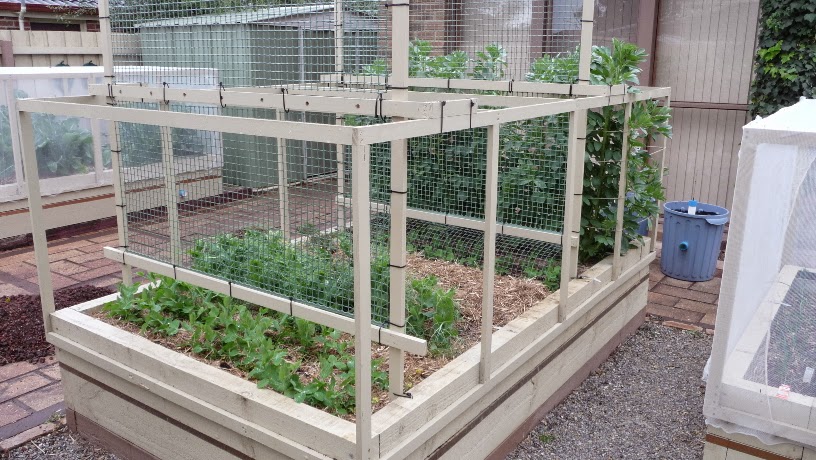
Ecobed4 is busy.  From right to left the rows contain, a few herbs (rosemary and thyme), a double row of climbing peas (just sown), a dense row of carrots, and a row of leeks.  The carrots and leeks are currently being harvested as required.  Out of sight at the other end of the bed is a row of broad beans (just sown).

The wire netting you can see in this bed keeps the pesky blackbirds from digging for worms.  


The capsicum in the end Ecobin is still ripening fruit, and when its finally finished, a late crop of peas will be sown.  The other bins have just been sown with peas (3 bins) and broad beans (1 bin). They were sown densely and may have to be thinned when they get bigger.

The netting is used to keep birds out.

08 April 2015

April 2015

I've decided to harvest these beetroot because I need to prepare the space for peas.  They are growing strongly and would get bigger if left a bit longer, but they're a nice size so out they come.  You can just see a few carrots behind the beetroot.  They will be pulled out at the same time.

These carrots will keep the supply coming.  They are densely planted and they will be small when I start pulling them out.  We like them like this, sweet and crisp and very more-ish.  I have also sown a row of beetroot replacements.  Got to keep them coming.

24 March 2015

March 2015 (2)

Ecobed 2 is about to be stripped (apart from the strawberries) in preparation for a green manure mix of Pea, Oat and Vetch.  Its a pity about the Bonfire Salvias, they are at their best, but time marches on and I will be following the green manure with my first sowing of potatoes in an Ecobed.

Its that time of year when I move my vegetables to the next bed in the 4 bed rotation.  Bed 4 (above) is half full of the previous season's light feeder crops, and the other half is being prepared for legumes.

These carrots should have been sown in the new Ecobed (Ecobed 1), but it wasn't ready in time.  They were sown thinly but haven't been thinned again since then.  I will harvest these early and enjoy finger sized carrots pulled out in bunches so I can clear them in time for some peas in early spring.

I always grow a few flowers in each bed to brighten things up and attract a few beneficial insects.

The Ecobins have been moved to a new space behind (new) Ecobed 1.  I've decided not to clean them out this year, instead I will prepare them for peas as I would with a full size Ecobed.  I'm quite pleased with the crop of Red Bull's Horn Capsicum in the Ecobin at the far end.  Sowing them early has done the trick.  The first 4 bins have had mulch and plant debris removed and a thick layer of compost added.  These were then covered with sugar cane mulch and a protective layer of shadecloth to keep the blackbirds out.  I plan to sow climbing greenfeast peas in them next month.

25 February 2015

March 2015

After a great season of Epicure climbing beans, I am leaving the remains of the crop to mature and dry out on the vine.   They will be stored as dried beans for rehydration and used in soups next winter.  Some of the best beans will be kept for use as seed for next season.

16 February 2015

February 2015 (2)

My Bull's Horn Capsicum were sown early this year, and I have been rewarded with healthy looking plants and plenty of capsicums.  They are starting to ripen and should be ready for harvest later this month.

My mini cabbages are growing strongly and are starting to set hearts.  The heavy duty shadecloth covering the bed has protected them well against the sun, and the vegenet has kept insect pests out of the bed.

I have just started a new brew of aerated compost tea and it's bubbling away merrily.  It will be ready tomorrow, and I will spray it on my edible crops to boost growth and strengthen their resistance to airborne pests.

08 February 2015

February 2015

Its the first week of February and the climbing bean harvest has reached the point where we are starting to store them for the cooler months.  I usually store the surplus in the freezer in zip lock bags, but this year we will run out of space, and I will be bottling some in brine sterilised in the pressure cooker.
They are starting to come thick and fast.

Despite the summer heat I am raising my seedlings in a lean-to mini greenhouse.  This is mainly to avoid whitefly damage, and its working well.  I water regularly by soaking the pots in about 15mm of water for an hour when needed, and I let them almost dry out between waterings.  These recycled vegetable trays are ideal for this.

The greenhouse is on a south facing fence, and is under the canopy of an apricot tree.  It gets about 3 hours of direct sunlight as it sets in the west.  The netting gives insect protection when the vent is open and cuts 20% of the sun's strength.  It doesn't seem logical to put seedlings in a greenhouse in high summer, but they dont seem to mind the heat, so long as they are shaded and protected from the wind.  When I get the chance I will build a stand to take a mini ecobed in the greenhouse to provide the continuous moisture and less frequent need of attention.

08 September 2014

September 2014 (2)

The heavy duty shadecloth on the legume Ecobed in this picture, was quickly wrapped around the pest exclusion frame last night to stop the broad beans blowing over when damagingly high winds came through the suburb.  The wind was quite violent with trees being blown down and houses losing their roofs all around Melbourne.  The shadecloth stayed in place thanks to the easy to use fastening system and there was minimal damage to my broad beans.
 
I have been refurbishing some of my Ecobins ready to plant Tomatoes.  I pulled them apart returning the used soil to one of my ornamental beds, and thoroughly cleaned everything else including the scoria.

I painted and reassembled the bins upgrading the overflow arangements as previously described.  New soil was taken from a drip irrigated garden bed and enriched with plenty of aged sheep manure.  A 60mm layer of home made compost was applied as a top dressing complete with worms harvested from my Ecobed worm farms.

I am experimenting this year with alternative water tank covers.  Instead of the heavy duty shadecloth used in previous years, I am using a layer of sugar cane straw in 2 of the bins, and coconut fibre matting in the others.  Hopefully they will be more effective at stopping soil getting into the water tanks without reducing water wicking capabilities.

Each Ecobin has an 1800mm star picket to support the Tomatoes as they grow.  Its held in place by the Scoria and soil, but for added security, I have tied them to the top rims of the bins with galvanised wire.

In about 4 weeks, the Tomatoes should be ready for planting, and the soil microbes will be fully active ready to start feeding them.

01 September 2014

September 2014 (1)


Its the first day of spring and after a week of beautiful mild, sunny, wind free days, its pouring down and its cold and blowing a gale.  Still, the garden's loving it.

As you can see I fitted exclusion netting last week.  We are already getting visits from those pesky Cabbage White Butterfies and Whiteflies.  I sprayed the Brassicas with Bacillus thuringiensis before fitting the nets to kill off a few caterpillars that had hatched and were starting to make a meal of my cauliflowers.

The light feeder bed is getting into a higher gear and I am harvesting lettuce and silverbeet at the moment.   I have planted my onions and a couple of replacement lettuce and the bed is full again.

The legume bed is generally OK, but I am disappointed with my dwarf peas.  Only a few flowers have set pods.  This is the second year this particular variety has failed, despite a great crop of climbing peas last year grown in the next row.  The broad beans are growing very well, are in full flower and are setting plenty of pods, so I think the dwarf peas might be getting too much nitrogen from my soil and putting on too much leaf growth.  We'll see how this years crop of climbing peas go.

All the vegies got a spray of aerated compost tea a couple of weeks ago, and so far there is no sign of mildew or rust on my legumes.

The wide row in the middle of the bed covered with mulch is being prepared for cucumbers and a butternut pumpkin.  I will be sowing seeds later this week, so I will need to build a third relocatable climbing frame for them soon.
This is the heavy feeder bed and I am harvesting broccoli, turnip and cauliflower at the moment, and the cabbages are not far away.  I have sown cabbage, turnip and broccoli seeds to be ready for transplanting into the vacated spaces once the soil is fed and matured in a couple of weeks time.

20 August 2014

August 2014 (2)

Nothing very exciting happens in the garden at this time of the year, but here is my mid-August update.  Everything is growing well, and I have started to build my second citrus tree Ecobed (Hamlin Orange). Broad beans are healthy, in flower and disease free, and I am harvesting Broccoli, Silverbeet, Turnips and Cauliflower. 

Its time to apply another foliar spray of aerated compost tea, and I will put the brew on tomorrow.

21 July 2014

July 2014

This is my last remaining drip line irrigated vegetable bed.  It has just been prepared for a crop of Potatoes.  When the potatoes are harvested in February next year, part of it will be converted into another 2.7m Ecobed .

The bed was prepared as follows:-
  • A cover crop of Vetch green manure was grown in the autumn.
  • The Vetch was harvested by chopping it down to the ground, leaving the roots in the soil (to capture the nitrogen in the root nodules).
  • The bed was dug to one spade depth.
  • The Vetch foliage was shredded and scattered over the soil.
  • A 60mm layer of home made compost was added (6 x 80 litre wheelbarrow loads).
  • Then a 20mm layer of aged sheep manure was raked over the top (6 x 25 litre bags).
  • Finally a 75mm layer of cane straw mulch was applied over the whole bed.
I am scheduled to sow potatoes in the second week of August (3 weeks).  By then, worm and microbial activity will have produced an ample supply of nutrients for the potatoes.
 

08 June 2014

June 2014


Most of the winter vegetables have been planted, and in this bed we have light feeders including,  lettuce, leeks, silverbeet, spinach, garlic, beetroot and carrots.  They have all germinated well and the weather has been mild for this time of year and unusually wet.
This bed contains legumes, and a few vegetables planted in summer which are still being harvested.  I am restricting myself to growing a single variety of peas and broad beans this winter.
The heavy feeders are all planted in this Ecobed and they include, broccoli, mini cauliflower, mini cabbage, and turnip.  The strawberry runners I planted as the first stage of a special 4 year rotation have established well and are looking healthy.

31 October 2013

October 2013

This blog is about how I grow vegetables in Garden Ecobeds.  Its a reference document for me really, but if you can get some benefit out of it, I will be delighted.
It takes into account our warm temperate climate with periods of occasional prolonged drought, and if you live in the northern hemishere, bear in mind this is Australia where the seasons are reversed (January is in the middle of summer here).

14 September 2013

September 14th 2013

This is my outside collection of herbs and vegetable seedlings.  As you can see I use a lot of labels to identify them, and a convenient way to make labels and reuse empty milkbottles is shown below.

01 September 2013

September 1st 2013.

Its spring in Melbourne, and the blossom is out in all its glory.  This small peach tree (3rd year) hasn't got the same amount of blossom as last year despite a summer pruning, but it looks healthy enough.